
Connected at the margins of imperialism? Vladivostok, London and the network of global shipping
Talk by Professor Madeleine Herren-Oesch. This is the third keynote talk of the conference "Spatial Imaginations of Europe: Ideas, Politics, Economics and Law" and covers a longue durée perspective of the conference themes.
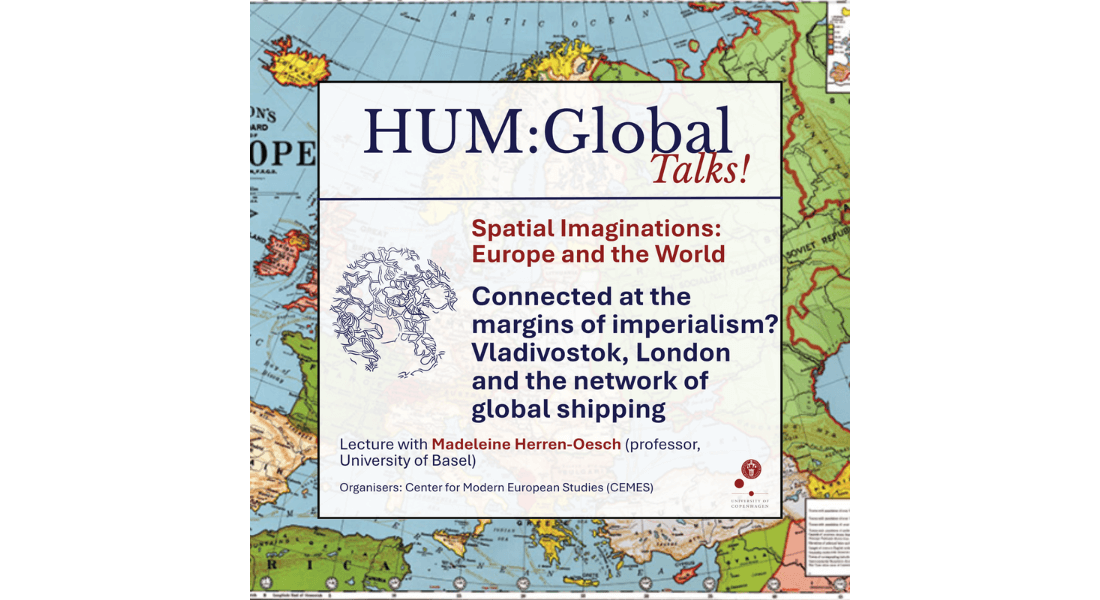
In the aftermath of the cataclysmic events of World War I, the newly established international order transformed Europe in crucial ways. Rather than Great Powers’ politics, the foundation of a multilateral system based in Geneva pursued the overarching objectives of engendering security and peace on a global scale. The profound postwar transformation that took place at all levels left a considerable impact on the European continent, encompassing the transition from monarchies to republics, from subjects to citizens, and from large empires to a multitude of nation-states. Furthermore, the end of the Old World appeared to correspond with the end of global connectivity driven by European imperialism.
The lecture invites a rethinking of Europe's Postwar as moment of deglobalization. Recent findings on seaborn services and trade have enabled a new reading of merchant shipping in the 1920s. The lecture will trace the emergence of a “Blue Europe”, a reconfiguration of seaborne services and trade whose patterns are still visible. In addition to London, widely regarded as the centre of British maritime power, the lecture discusses Vladivostok as a global hub, and its significant resonance across Europe.
Bio
Madeleine Herren-Oesch is a professor emerita of modern history and a former director of the Institute for European Global Studies at the University of Basel, Switzerland. From 2007 to 2012 she co-directed the Cluster of Excellence Asia and Europe in a Global Context at Heidelberg University, Germany. She has written several books, chapters and articles on the European and global history of the 19th and 20th centuries, internationalism, the history of international organisations and networks in historical perspective, historiography and intellectual history. She is interested in the impact of digital methods on historical research and historiography. Her current research interests focus on global shipping and the importance of the polar regions for understanding changing global interconnectedness beyond nation states and empires.
Map of South Campus
View directions.
View on map of the Faculty of Humanities - South Campus.
View map of South Campus (pdf).