
LESEORTE (Sites of Reading)
International Conference at the University of Basel (Switzerland) in cooperation with the University of Copenhagen (Denmark)
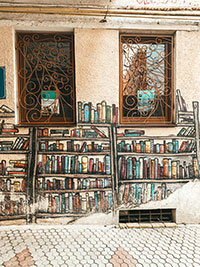 While the history of the media is primarily concerned with the tools, formats and objects of reading, research into sites and scenes of reading also examines the relationship between reading and the places in which it takes place. These places sometimes make reading possible in an encouraging way; sometimes reading takes place in spite of what surrounds the reader.
The place of reading seems merely contingent, no more than what surrounds the reader, whether enabling or disrupting, and so it is seldom investigated in its own right. The desire to read not only draws us to those places designed for that purpose: an armchair, a library, a bookshop, a coffee house, a seminar room or a salon; we also find ourselves wishing or needing to read in quite different locations, not always convenient or conducive to concentration. Conversely, the settings of the books we read can transport us to other places.
Whether read on a park bench or in prison, in a shabby basement or in a luxurious hotel room, literature can transport its readers to places of greatest contrast. But what makes such diverse places into places of reading? Is there a way in which they can be defined, described, categorized? Do they need to be understood within their own context? Or do they emerge from the sum of institutional frameworks, the technologies employed and the atmospheres created, by silent images or by moving bodies?
The aim of the conference is to highlight places of reading as an integral yet neglected aspect of the act of reading, viewing them not merely as contingent spaces or frameworks for reading. It is only through reading the spaces of reading that scenes of reading become legible. This concept can be applied to real and imagined places of reading, extending beyond literature. The choice of reading space directly impacts the concept of reading itself, as each place brings with it specific affordances. What is read and how it is read are inextricably linked to the question of where reading takes place.
More information about event (in German).
Speakers
- Christian Benne (Copenhagen)
- Matthias Bickenbach (Cologne)
- Natalie Binczek (Bochum)
- Charlotte Coch (Basel)
- Sina Dell’Anno (Berkeley/Vienna)
- Lena Hintze (Innsbruck)
- Irina Hron (Copenhagen)
- Thomas Macho (Berlin)
- Harun Maye (Basel)
- Werner Michler (Salzburg)
- Klaus Müller-Wille (Zurich)
- Günther Stocker (Vienna)
- Rahel Villinger (Zurich)
Contact: Irina Hron (irina.hron@hum.ku.dk) / Harun Maye (harunchristian.maye@unibas.ch)
The seminar is organized by the University of Basel in cooperation with the CEMES research group Thinking the European Republic of Letters.